
Sri Lankan Sloth Bear at Yala: Facts, Behaviour & How to Spot One
The sloth bear is the third of the “big three” animals every visitor hopes to see on a Yala safari, alongside the Sri Lankan leopard and the Sri Lankan elephant. It’s also the hardest of the three to spot, and the one most first-time visitors know least about. Here’s what makes Yala’s sloth bears distinctive, how they behave, how they raise their young, and when your odds of seeing one are genuinely good.
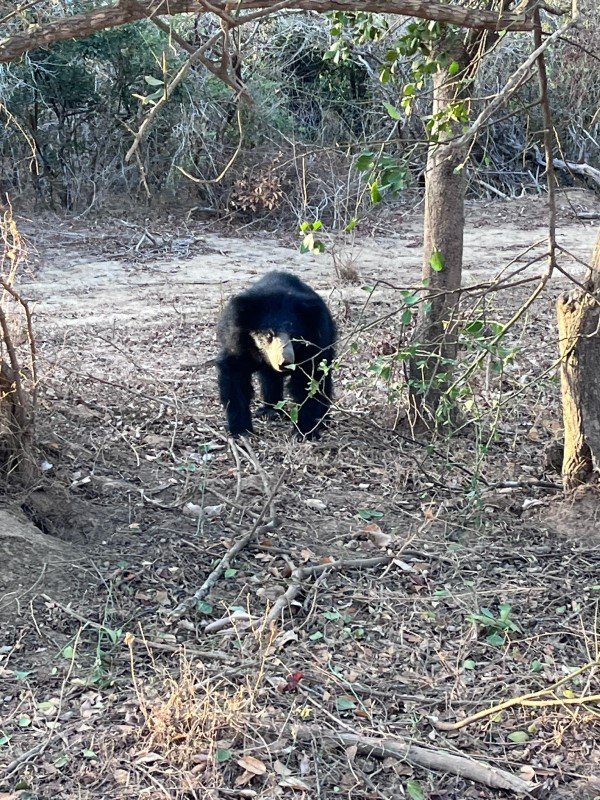
Quick facts
| Scientific name | Melursus ursinus inornatus |
| Found | Sri Lanka only, a smaller subspecies than the sloth bears of India and Nepal |
| Weight | Adult males roughly 80–140 kg, females noticeably smaller |
| Tail | Up to about 18 cm (7 inches), the longest tail of any bear species |
| Diet | Mostly termites and ants, plus fruit, roots, and carrion |
| Litter size | Usually 1–3 cubs, most often 2 |
| IUCN status | Vulnerable |
| Best sighting months in Yala | May to August (palu fruiting season) |
What makes the Sri Lankan sloth bear distinctive
The sloth bears found in Yala belong to the subspecies Melursus ursinus inornatus, found only in Sri Lanka and smaller on average than the sloth bears of India and Nepal. Adults have a shaggy black coat and a pale, often V or Y-shaped patch of fur across the chest. Each bear carries this marking a little differently, and guides sometimes use it to recognise individuals seen more than once.
Two features set them apart from other bears. Their snout is long and mobile, built for pulling insects out of tight spaces, and they’re missing the upper front incisors other bears have. That gap lets them seal their nostrils and pull air through their mouth, which is how they suck up termites and ants almost like a vacuum. Their claws are long and curved, made for tearing open anthills and termite mounds rather than for climbing, though sloth bears climb well anyway.
Their tail is also unusual. At up to 18 cm, it’s the longest tail relative to body size of any bear species, though it’s mostly hidden under the shaggy coat and easy to miss on safari. And despite a slow, shambling gait, sloth bears can outrun a person over short distances if startled. They look clumsy. They aren’t.
Diet and feeding behaviour
Sloth bears are omnivorous, but insects make up most of their diet. Termites and ants are the staple, dug out of mounds and rotting logs with those long claws and snout. A feeding bear is often heard before it’s seen: the vacuuming and slurping sound of a sloth bear working a termite mound can carry close to 100 metres, which is one of the more reliable ways guides know one is nearby.
Fruit matters too, and one fruit matters more than any other. Palu (Manilkara hexandra) is a native tree that ripens in the dry season, and when it fruits, sloth bears gather to feed, sometimes climbing high into the branches and staying there for hours. Madan (Syzygium cumini) and weera (Drypetes sepiaria) fruit around the same period and draw bears as well, though in smaller numbers than palu. Bears that gorge on fallen, half-fermented fruit are occasionally seen sleeping it off at the base of a tree rather than moving on. In return for the meal, bears spread palu seeds through the forest in their droppings, which makes them a small but real part of how these trees regenerate.
Beyond insects and fruit, sloth bears eat roots and carrion, and only rarely hunt live prey. Outside of palu season, they’re mostly nocturnal and solitary, sleeping through the heat of the day and moving at dusk, night, and dawn. That’s part of why they’re seen far less often than leopards or elephants, both of which stay active well into daylight hours.
Reproduction and how cubs are raised
After mating, gestation runs roughly six to seven months, and a female usually gives birth to one to three cubs, most often two, in a den under rocks or dense cover. For the first three to eight weeks she stays in the den almost continuously and doesn’t leave to feed or drink.
Once the cubs are mobile, the sloth bear does something no other bear species does as a matter of habit: the mother carries her cubs on her back, sometimes for the first seven to nine months of their lives. It’s thought to protect the cubs from ground-level predators, leopards especially, while they’re still too small to keep pace or defend themselves. A mother sloth bear with cubs riding along is one of the more memorable sights in Yala, though it’s also a rare one, since females with young stay especially cautious and keep to the densest cover.
Best time and place to spot one in Yala
Sightings cluster around the palu fruiting season, roughly May through August, when bears spend more time out in the open feeding rather than hidden in dense scrub. Early morning and late afternoon safaris give the best odds, matching the bears’ natural activity pattern.
Sloth bears favour the dry scrub and forest patches of Yala’s interior rather than the open plains where elephants graze. Block 5 in particular has more forest cover and a reputation among guides for slightly better bear activity than the more open, more heavily driven Block 1, though Block 1 still produces regular sightings during palu season. Our guides watch for fresh diggings at termite mounds, torn-open anthills, and overturned logs along the park’s tracks. Those signs, more than anything else, tell us a bear has been through recently and is worth slowing down for.
Are sloth bears dangerous?
Sloth bears are shy by nature and go out of their way to avoid people. In parts of their range on the Indian subcontinent, though, they have a reputation for reacting aggressively when surprised at close range on foot, more so than tigers do in the same regions, simply because a startled bear with poor eyesight tends to defend itself first and identify the threat second.
That risk applies to people on foot, not to guests in a safari jeep. On a Yala safari you view sloth bears from inside the vehicle at a distance the guide controls, and the bears themselves show no interest in a parked jeep. Guests staying seated inside the vehicle are not at risk from any of the animals a Yala safari encounters, sloth bears included.
Sloth bear vs leopard vs elephant: sighting odds
| Activity pattern | Sighting difficulty | |
| Sloth bear | Mostly nocturnal, solitary, active by day mainly during palu season | Hardest of the three |
| Leopard | Active by day and night, rests on rocks and in trees | Moderate, best around dawn and dusk |
| Elephant | Active through the day, moves in herds or as solitary bulls | Easiest, sightings are near-guaranteed |
If a sloth bear sighting is the priority for your trip, a full-day safari during palu season gives you the most time in the park across the bears’ most active hours. See our guide to safari package lengths for how the different tour durations compare.
Conservation status
The sloth bear is listed as Vulnerable by the IUCN and protected under Sri Lanka’s Fauna and Flora Protection Ordinance. Habitat loss from agricultural expansion and human settlement is the main pressure on the population, since sloth bears need large, connected areas of forest and scrub to find enough termite mounds and fruiting trees to survive.
Yala remains one of the more reliable places in the country to see a sloth bear in the wild. Wilpattu, Wasgamuwa, and Kumana National Parks also hold populations, but none draws as many visitors or offers the same odds during palu season as Yala does.
Book your Yala safari
Menaka Safari runs morning, afternoon, and full-day jeep safaris into Yala National Park, with an experienced guide watching for all three of the park’s signature animals. For sloth bear season specifically, a morning or late-afternoon safari during May to August gives you the best shot. See our guide to safari package lengths, check our packages, or get in touch to book.
Frequently asked questions
Are sloth bears dangerous? Sloth bears are shy and avoid human contact, but like any wild animal they can react defensively if surprised at close range on foot. On safari, you’ll always view them from inside the jeep at a safe distance the guide controls.
When is the best time to see a sloth bear in Yala? Roughly May through August, during the palu fruiting season, when bears spend more time feeding in the open. Early morning and late afternoon safaris match their natural activity pattern.
How rare are sloth bear sightings compared to leopards and elephants? Rarer. Sloth bears are mostly nocturnal and solitary, while leopards and elephants are both active during daylight hours, which makes them easier to find on a standard safari.
What do sloth bears eat? Mostly insects, especially termites and ants pulled from mounds with their long claws and snout. They also eat fruit, particularly palu, along with madan, weera, roots, and carrion.
Do sloth bear cubs really ride on their mother’s back? Yes. It’s a trait unique to sloth bears among bear species. Cubs ride on their mother for their first seven to nine months, likely as protection from ground-level predators like leopards.
Can sloth bears climb trees? Yes, and well. Their long claws, built mainly for digging, also work for climbing, and bears regularly climb palu trees during fruiting season to feed directly from the branches.
Where else in Sri Lanka can you see sloth bears? Wilpattu, Wasgamuwa, and Kumana National Parks also have sloth bear populations, but Yala remains one of the most visited and reliable locations for a sighting.
